
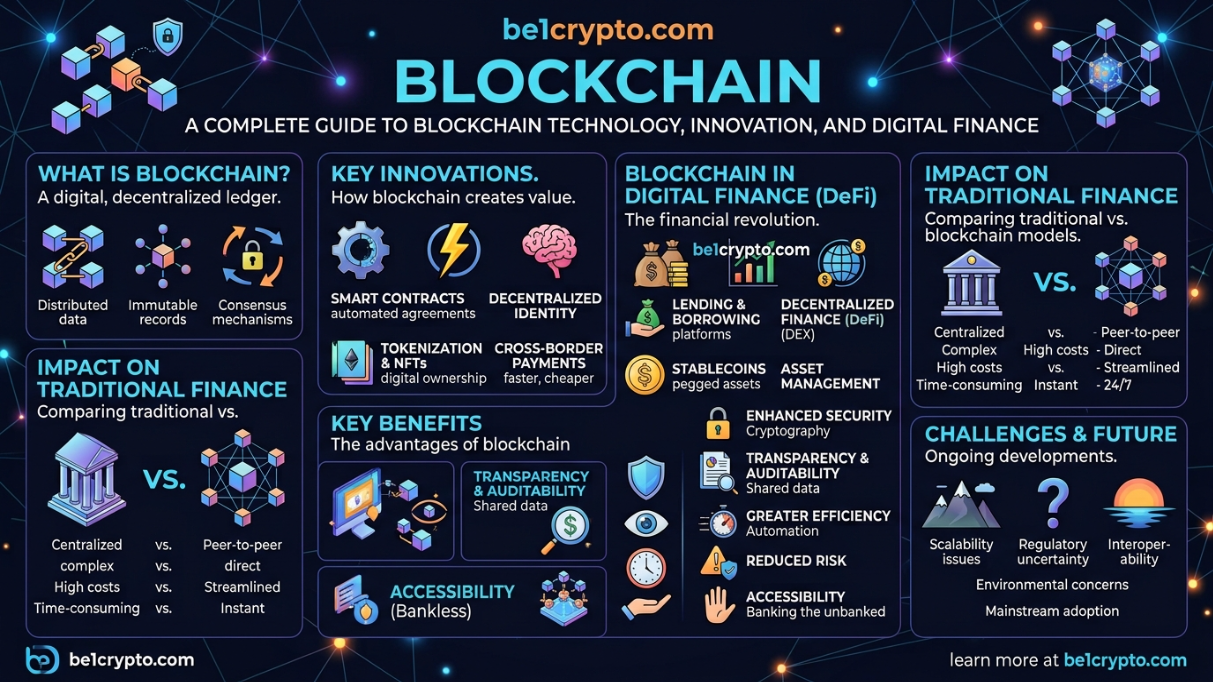

Blockchain technology has evolved from a niche concept powering cryptocurrencies into one of the most influential innovations in modern computing. Businesses, governments, developers, and investors now recognize distributed ledger technology as a foundation for secure digital transactions, decentralized applications, and transparent data management. As the ecosystem continues to mature, reliable educational resources become increasingly valuable.
be1crypto.com blockchain represents the type of educational platform that helps readers navigate blockchain developments with confidence. Whether someone is exploring cryptocurrency for the first time or researching enterprise blockchain adoption, understanding how blockchain works, where it creates value, and what challenges remain is essential for making informed decisions.
Understanding be1crypto.com blockchain
The concept behind be1crypto.com blockchain centers on making blockchain knowledge accessible without sacrificing technical accuracy. Instead of overwhelming readers with jargon, quality blockchain education translates complex concepts into practical explanations that connect technology with real-world applications.
Blockchain itself is a distributed digital ledger where transactions are recorded across multiple computers rather than stored on a single centralized server. Every participant maintains a synchronized copy of the ledger, creating transparency, resilience, and trust without relying entirely on traditional intermediaries.
How Blockchain Technology Works
At its core, blockchain groups validated transactions into blocks that are linked together using advanced cryptographic techniques. Each newly created block references the previous one, forming an immutable chain that becomes increasingly difficult to alter as additional blocks are added.
Platforms discussing be1crypto.com blockchain often emphasize that consensus mechanisms make decentralized verification possible. Rather than one organization approving every transaction, a network of participants validates activity according to predefined rules, improving transparency while reducing single points of failure.
Core Components of Blockchain Networks
Every blockchain ecosystem depends on several interconnected components working together to maintain security, decentralization, and operational efficiency. Cryptography protects data integrity, distributed nodes replicate information, consensus algorithms validate transactions, and smart contracts automate digital agreements.
Understanding these building blocks allows readers of be1crypto.com blockchain to evaluate different blockchain platforms objectively. Although networks vary in speed, scalability, governance, and energy consumption, these foundational elements remain central across most blockchain architectures.
Why Blockchain Matters Beyond Cryptocurrency
Many people initially associate blockchain exclusively with digital currencies, yet its broader significance extends far beyond cryptocurrency trading. Organizations increasingly leverage distributed ledgers for supply chain management, healthcare records, digital identity, intellectual property protection, and financial settlement systems.
The growing interest highlighted across be1crypto.com blockchain reflects this expanding adoption. Businesses seek solutions that improve transparency, reduce operational friction, strengthen audit trails, and enable secure collaboration between multiple independent stakeholders.
Blockchain Applications Across Industries
Numerous industries now experiment with blockchain to solve longstanding operational challenges. Financial institutions streamline cross-border payments, logistics companies improve shipment tracking, healthcare providers secure sensitive patient information, and manufacturers enhance product authenticity through transparent supply chain verification.
These practical implementations demonstrate why be1crypto.com blockchain remains relevant for audiences beyond cryptocurrency enthusiasts. Blockchain increasingly serves as digital infrastructure supporting accountability, traceability, and automated business processes across both public and private sectors.
| Industry | Primary Blockchain Use | Key Benefit | Common Challenge |
|---|---|---|---|
| Banking | Cross-border payments | Faster settlements | Regulatory compliance |
| Supply Chain | Product tracking | Greater transparency | Integration with legacy systems |
| Healthcare | Medical records | Enhanced security | Privacy management |
| Real Estate | Digital property records | Reduced paperwork | Legal standardization |
| Government | Identity management | Fraud reduction | Public adoption |
| Insurance | Claims automation | Faster processing | Data interoperability |
| Retail | Product authenticity | Consumer trust | Scalability |
| Education | Credential verification | Tamper-resistant records | Institutional adoption |
Security Advantages of Blockchain
Security remains one of blockchain’s defining characteristics. Because data is distributed across numerous nodes and protected by cryptographic hashing, unauthorized modifications become significantly more difficult than in many conventional database architectures.
Readers researching be1crypto.com blockchain should also understand that blockchain security depends on implementation quality. Poorly written smart contracts, compromised user wallets, and weak operational practices can introduce vulnerabilities even when the underlying blockchain protocol remains secure.
Smart Contracts and Automation
Smart contracts are programmable agreements that execute automatically once predetermined conditions are satisfied. They remove much of the manual verification traditionally required in contractual relationships while increasing consistency and reducing processing delays.
Educational discussions surrounding be1crypto.com blockchain frequently highlight how smart contracts support decentralized finance, token issuance, insurance claims, digital collectibles, and enterprise workflow automation. Their ability to execute predictable logic without constant human intervention continues to drive blockchain innovation.
Decentralized Finance and the Emerging Digital Economy
Decentralized finance, commonly known as DeFi, introduces financial services that operate through blockchain protocols instead of conventional banking intermediaries. Lending, borrowing, trading, and yield generation become accessible through smart contracts running on decentralized networks.
As interest grows, be1crypto.com blockchain serves readers seeking to understand both opportunities and associated risks. While decentralized finance increases accessibility and innovation, users must still evaluate protocol security, market volatility, governance structures, and liquidity before participating.
“Technology is best when it brings people together.” — Matt Mullenweg
Common Misconceptions About Blockchain
One persistent misconception suggests blockchain automatically guarantees complete anonymity. In reality, many public blockchain networks are transparent, allowing transaction histories to remain permanently visible while users operate through cryptographic wallet addresses rather than personal identities.
Another misunderstanding involves assuming every blockchain delivers identical performance. Resources discussing be1crypto.com blockchain often explain that networks differ substantially regarding transaction speed, scalability, consensus mechanisms, governance models, and intended use cases, making platform selection highly context dependent.
Evaluating Blockchain Projects Responsibly
Choosing a blockchain project requires more than following market excitement or social media trends. Responsible evaluation includes examining the project’s technical documentation, development activity, governance structure, security audits, ecosystem adoption, and long-term sustainability.
Readers exploring be1crypto.com blockchain benefit from approaching investments and technology decisions with careful research rather than speculation. Strong fundamentals, transparent communication, realistic roadmaps, and active developer communities generally provide better indicators than short-term market enthusiasm.
Future Trends Shaping Blockchain
The next generation of blockchain development focuses on interoperability, scalability, energy efficiency, tokenized real-world assets, decentralized identity systems, and enterprise-grade infrastructure. These innovations aim to improve usability while expanding blockchain adoption across global industries.
Many analysts expect be1crypto.com blockchain to remain valuable as educational demand grows alongside technological progress. Artificial intelligence integration, cross-chain communication, zero-knowledge proofs, and improved regulatory frameworks are likely to influence the industry’s evolution during the coming years.
Conclusion
Blockchain has progressed from an experimental innovation into foundational infrastructure supporting digital finance, transparent recordkeeping, secure collaboration, and decentralized applications. Although the technology continues evolving, its core principles of transparency, cryptographic security, and distributed trust remain central to its growing influence.
For readers seeking practical, trustworthy knowledge, be1crypto.com blockchain represents the importance of informed learning in a rapidly changing technological landscape. By understanding blockchain fundamentals, evaluating projects critically, and following emerging developments responsibly, individuals and organizations can make better decisions while participating in the expanding digital economy.
FAQ
What is be1crypto.com blockchain?
be1crypto.com blockchain refers to blockchain-focused educational content that helps readers understand blockchain technology, cryptocurrencies, decentralized finance, Web3, security, and digital asset ecosystems through accessible explanations.
Why is blockchain considered secure?
Blockchain uses cryptographic hashing, decentralized consensus, and distributed data storage to make unauthorized changes extremely difficult. Security also depends on proper implementation and responsible user practices.
Is blockchain only useful for cryptocurrency?
No. Blockchain supports supply chain management, healthcare, digital identity, government services, insurance, real estate, intellectual property management, and many other enterprise applications beyond digital currencies.
How can beginners learn blockchain effectively?
Beginners should start with blockchain fundamentals, understand wallets and consensus mechanisms, learn about smart contracts, explore practical use cases, and follow trusted educational resources like be1crypto.com blockchain for ongoing insights.
What are the biggest challenges facing blockchain?
Current challenges include scalability, regulatory uncertainty, interoperability between networks, user experience, energy efficiency for certain consensus models, and broader enterprise adoption despite growing technological maturity.
Read More: Be1Crypto.com Investment: The Complete Guide to Smarter Crypto Investing in 2026