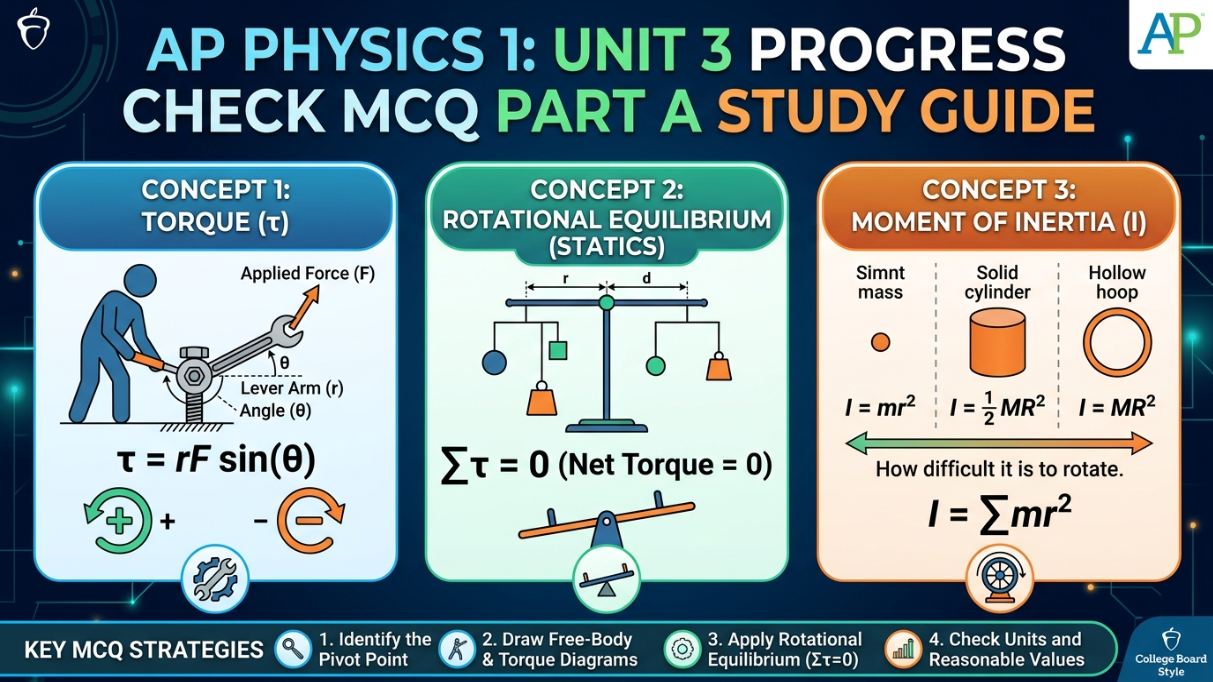

Preparing for unit 3 progress check mcq part a ap physics can feel challenging because this section evaluates much more than memorized formulas. Students must understand the relationships between force, motion, energy, and experimental reasoning while applying concepts in unfamiliar situations. Success comes from building conceptual understanding rather than relying solely on equation memorization.
This comprehensive guide explains what the assessment measures, the core physics principles involved, effective preparation strategies, common mistakes, and practical techniques that help students perform confidently on AP Physics multiple-choice questions.
Understanding Unit 3 Progress Check MCQ Part A AP Physics
The unit 3 progress check mcq part a ap physics assessment is designed to measure conceptual mastery of mechanics topics through multiple-choice questions that emphasize reasoning over computation. Students are expected to analyze physical situations, interpret diagrams, and determine which physics principles best explain observed behavior.
Unlike traditional classroom quizzes, these progress checks focus on scientific thinking. Rather than asking students to simply calculate numerical answers, many questions evaluate the ability to predict outcomes, compare physical systems, recognize patterns, and justify conclusions using established physics laws.
What Concepts Are Commonly Tested?
Although individual assessments vary, the topics typically center on forces, Newton’s Laws, free-body diagrams, acceleration, motion analysis, interactions between objects, and the relationships that govern mechanical systems. Students should also understand how graphical representations connect with physical behavior.
Many questions require combining multiple concepts instead of testing isolated facts. For example, a single scenario may involve interpreting motion graphs, identifying forces acting on an object, and predicting how acceleration changes after an interaction, making conceptual integration especially important.
Why Conceptual Understanding Matters
One of the biggest misconceptions is that success depends on memorizing formulas. In reality, unit 3 progress check mcq part a ap physics rewards students who understand why equations work and when they apply.
When students develop intuition about forces and motion, they can solve unfamiliar problems without relying on memorization alone. This deeper understanding also improves performance on future AP Physics units because many concepts continue building throughout the course.
Core Skills Evaluated During the Assessment
The assessment emphasizes scientific reasoning as much as factual knowledge. Students are expected to evaluate evidence, interpret experimental results, identify assumptions, and recognize the limitations of simplified physical models.
Graph interpretation, proportional reasoning, qualitative analysis, and estimation skills frequently appear alongside mathematical calculations. Developing these broader scientific skills often leads to stronger overall AP Physics performance beyond a single progress check.
Study Strategies That Produce Better Results
Effective preparation begins with reviewing classroom notes alongside conceptual explanations instead of immediately jumping into practice questions. Students should understand the physical meaning behind every major equation before attempting timed practice.
Working through mistakes is equally important. Rather than simply marking an incorrect answer, successful students identify why their reasoning failed, which misconception influenced the choice, and how the correct physics principle changes the outcome.
Common Mistakes Students Make
Many students rush through diagrams without carefully identifying every force acting on an object. Small errors in free-body diagrams frequently lead to incorrect conclusions about acceleration, equilibrium, or net force.
Another common issue is treating formulas as interchangeable tools. Strong performance on unit 3 progress check mcq part a ap physics requires recognizing which relationships accurately describe a specific physical situation before selecting an equation.
Comparison of Essential Topics and Study Focus
| Topic | What You Should Understand | Common Mistake | Best Study Method |
|---|---|---|---|
| Newton’s First Law | Inertia and equilibrium | Confusing balanced forces with no motion | Analyze real-life examples |
| Newton’s Second Law | Relationship between force, mass, and acceleration | Using equations without identifying net force | Practice free-body diagrams |
| Newton’s Third Law | Action-reaction force pairs | Assuming forces cancel because they are equal | Compare interacting objects |
| Free-Body Diagrams | External forces only | Including internal forces | Draw diagrams before solving |
| Motion Graphs | Position, velocity, and acceleration relationships | Misreading slope or area | Interpret multiple graph types |
| Force Interactions | Combined effects of several forces | Ignoring friction or tension | Practice qualitative reasoning |
| Experimental Analysis | Variables, assumptions, and conclusions | Focusing only on calculations | Explain results in words |
How to Approach Multiple-Choice Questions
Reading the entire scenario before examining answer choices helps prevent premature assumptions. Many distractors appear correct only because they match common misconceptions, making careful reading essential.
Students should eliminate obviously incorrect options before comparing the remaining choices. This process improves accuracy while reducing cognitive overload, especially during timed sections of unit 3 progress check mcq part a ap physics.
The Importance of Practice Under Real Exam Conditions
Timed practice develops familiarity with the pacing required for AP-style assessments. Students who regularly complete realistic practice sessions often become more comfortable recognizing patterns in question design.
After each practice session, reviewing every question—including those answered correctly—helps reinforce sound reasoning. Understanding why an answer is correct is just as valuable as identifying why incorrect choices are wrong.
Using Physics Reasoning Instead of Memorization
Physics is fundamentally about understanding relationships between measurable quantities. When students visualize how forces influence motion, they naturally arrive at correct conclusions even in unfamiliar scenarios.
This reasoning-based approach is especially valuable when multiple concepts interact. Instead of searching for a memorized formula, students analyze the physical situation step by step before selecting the most appropriate solution strategy.
“The important thing is not to stop questioning. Curiosity has its own reason for existing.” — Albert Einstein
This perspective reflects the spirit of AP Physics. Curiosity and logical reasoning consistently outperform rote memorization when solving complex conceptual problems.
Building Long-Term Success Beyond Unit 3
Mastering unit 3 progress check mcq part a ap physics provides a strong foundation for later topics involving momentum, energy, rotational motion, and more advanced mechanics. The analytical skills developed here continue throughout the AP curriculum.
Students who consistently review concepts, practice scientific reasoning, and learn from mistakes often find later units significantly more manageable because the same principles of careful analysis remain essential.
Conclusion
Preparing for unit 3 progress check mcq part a ap physics requires much more than remembering equations. Students achieve the best results by understanding physical principles, interpreting diagrams accurately, analyzing experimental situations, and practicing with purpose.
A balanced preparation strategy combines conceptual learning, targeted practice, thoughtful error analysis, and consistent review. By focusing on scientific reasoning rather than memorization alone, students build both higher assessment scores and a deeper appreciation for physics itself.
FAQ
What is unit 3 progress check mcq part a ap physics?
It is a multiple-choice assessment that measures conceptual understanding of mechanics, forces, motion, and scientific reasoning within the AP Physics curriculum.
How difficult is unit 3 progress check mcq part a ap physics?
The difficulty comes from applying concepts in unfamiliar situations rather than performing lengthy calculations. Strong conceptual understanding makes the assessment much more manageable.
How should I study for unit 3 progress check mcq part a ap physics?
Focus on Newton’s Laws, free-body diagrams, motion graphs, experimental reasoning, and regular timed practice while reviewing every mistake carefully.
Are formulas enough to succeed on unit 3 progress check mcq part a ap physics?
No. While formulas are important, the assessment primarily evaluates conceptual reasoning, interpretation, and the ability to apply physics principles correctly.
What is the biggest mistake students make?
Many students memorize equations without understanding when or why they apply. Careful analysis of physical situations and accurate free-body diagrams are far more valuable.
Can practicing conceptual questions improve AP Physics performance overall?
Yes. Conceptual reasoning skills developed while preparing for unit 3 progress check mcq part a ap physics strengthen performance across later AP Physics topics because the course builds on the same analytical foundations.
Read more: CCNA Gold 1 Final Test: The Complete Guide to Exam Success